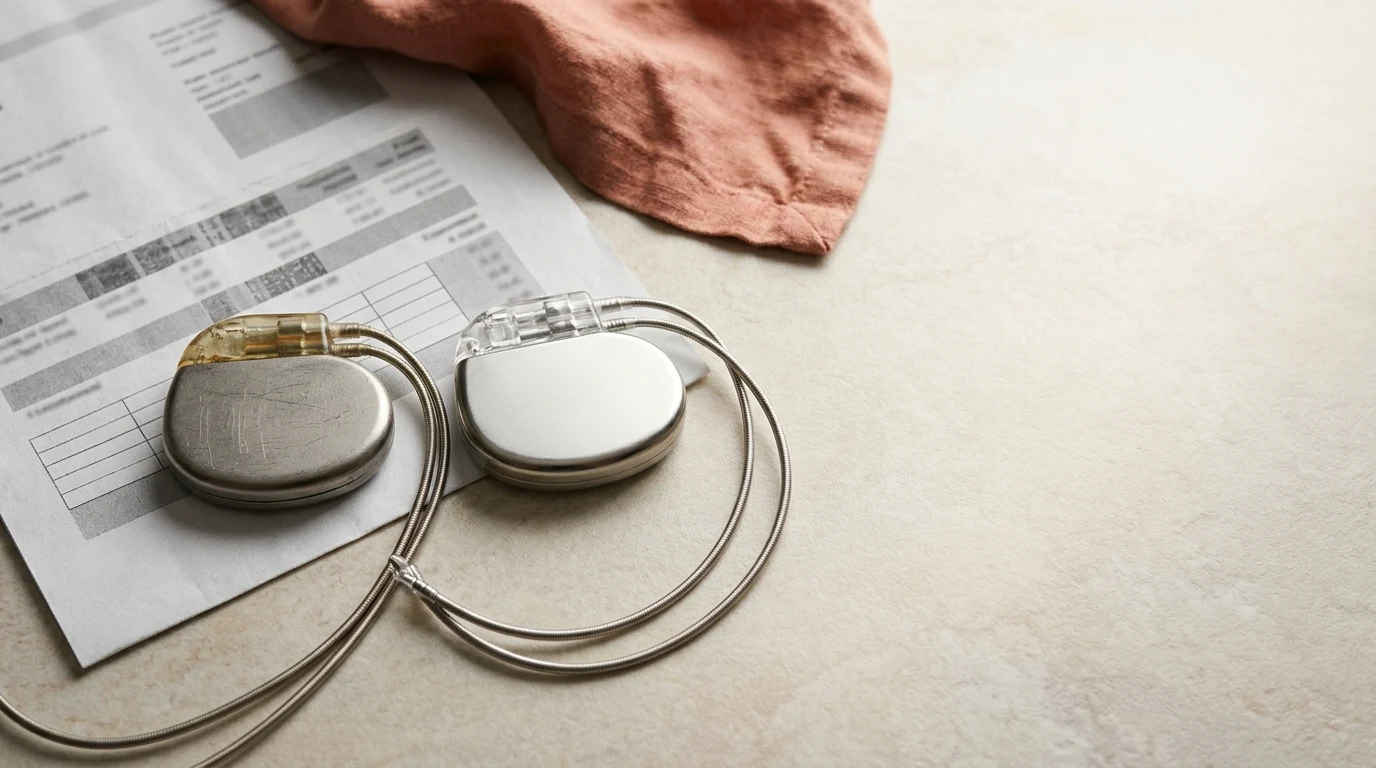
A pacemaker "battery replacement" is a full device replacement, and Medicare prices it that way. The battery is sealed inside the generator, so the cardiologist takes out the whole generator and connects a new one to your existing leads. For a dual-chamber pacemaker, Medicare's 2026 hospital outpatient payment for that swap is $10,678, which is exactly what it pays for a brand-new dual-chamber implant with new leads. Your own share is a different story. A rule most cost articles leave out caps the hospital part of your bill, so on Original Medicare you will usually owe somewhere around $1,750 to $2,100, not 20% of a $50,000 hospital bill.
Why the replacement costs nearly as much as the first implant
What you are paying for is the device, not the operation. A generator change is a short procedure: the old generator is lifted out of the pocket under your collarbone, the leads are tested and reattached, and the pocket is closed, usually as a same-day outpatient visit under local anesthetic and sedation. Medicare's numbers show where the money goes. In 2026 it pays the physician $315 for a dual-chamber generator replacement (CPT 33228), and pays the hospital $10,678 for the same visit. (CMS, CY2026 Physician Fee Schedule final rule; CMS, CY2026 OPPS final rule, Addendum B)
The hospital payment is large because it has to cover the new generator. Medicare sorts outpatient procedures into payment groups, and it places the dual-chamber swap in the same group (APC 5223, "Level 3 Pacemaker and Similar Procedures") as a first-time dual-chamber implant with leads (CPT 33208). Leads are cheap next to the generator, so leaving them in place barely changes the price.
| 2026 Medicare national rate | Hospital outpatient | Surgery center (ASC) | Physician fee |
|---|---|---|---|
| Single-lead generator replacement (33227) | $8,455 | $6,436 | $302 |
| Dual-lead generator replacement (33228) | $10,678 | $7,554 | $315 |
| Multi-lead (biventricular) replacement (33229) | $19,679 | $13,528 | $330 |
| For comparison: new dual-chamber implant with leads (33208) | $10,678 | $7,739 | $456 |
These are national figures before Medicare's local wage adjustment, so the exact amount at your hospital will be somewhat higher or lower. (CMS, CY2026 ASC payment rates, Addendum AA)
The cap that changes your math
Medicare limits what you pay a hospital outpatient department for one procedure. By law, your coinsurance for a single outpatient hospital service cannot be more than that year's Part A inpatient deductible, which is $1,736 in 2026. (42 CFR 419.41; CMS, 2026 Medicare deductibles fact sheet)
For a dual-chamber swap, the cap is what you actually pay. Twenty percent of $10,678 is $2,136, which is over the cap, so your hospital share stops at $1,736. Even in lower-wage areas, where Medicare's adjusted rate is lower, 20% of it stays above the cap. A single-chamber swap comes in just under: 20% of $8,455 is $1,691.
The cap covers the hospital's part of the bill only. The physician's fee is billed separately at your normal 20%, but on a $315 fee that is about $63. If an anesthesiologist rather than the cardiology team handles sedation, that is another separate bill, which our guide to why anesthesia arrives as its own bill walks through.
What you would owe, by coverage
Most of the difference between patients comes from their coverage, not from the hospital they choose. The figures below use 2026 national rates and assume nothing unusual happens during the procedure.
| Your coverage | Dual-chamber swap, hospital outpatient | Dual-chamber swap, surgery center |
|---|---|---|
| Original Medicare only, Part B deductible already met | About $1,800 ($1,736 capped facility share + ~$63 physician) | About $1,575 (20% of $7,554 + ~$63 physician) |
| Original Medicare only, deductible not yet met | Add up to $283 | Add up to $283 |
| Original Medicare + Medigap Plan G | $283 at most (the Part B deductible) | $283 at most |
| Medicare Advantage | Your plan's outpatient surgery copay or coinsurance | Your plan's surgery center copay |
Medigap Plan G pays your Part B coinsurance in full once the annual deductible is met, so the device price never reaches you. (Medicare.gov, Medigap plan benefits) Medicare Advantage plans set their own cost sharing, so the plan's Evidence of Coverage is the document to check. Your ceiling there is the plan's in-network out-of-pocket maximum, which cannot exceed $9,250 in 2026.
Why a surgery center saves less than you would expect
Medicare pays a surgery center 25% to 30% less than a hospital for the same swap, but your savings are much smaller, because the cap only protects you at the hospital. Surgery center coinsurance is a plain 20% of the center's rate, with no cap. (42 CFR 416.172) For a dual-chamber swap, Medicare pays the hospital $3,124 more than the center. Your share goes from about $1,800 to about $1,575, a difference of roughly $225. For a single-chamber swap, the gap is closer to $400 ($1,751 versus $1,347).
That still adds up to real money, and it is worth asking whether your cardiologist does generator changes at a surgery center. But it should not be the deciding factor. If your cardiologist only does them at the hospital, or your heart condition makes the hospital the safer place, the cap keeps the extra cost to a few hundred dollars. Our comparison of inpatient and outpatient surgery costs covers why the setting matters more for other procedures.
What the hospital bills before Medicare steps in
The number on the hospital's itemized statement will look nothing like what Medicare pays. In CMS's hospital outpatient data for 2023, the Level 3 pacemaker group, which includes both dual-chamber generator swaps and new dual-chamber implants, had a median average billed charge of about $49,600 across 1,322 hospitals. The median Medicare payment for the same group was about $8,240. A tenth of hospitals billed under about $28,500, and 127 hospitals billed over $100,000. (CMS, Medicare Outpatient Hospitals by Provider and Service, 2023 data)
If you are on Medicare, those charges are mostly irrelevant to you, because your share is based on Medicare's rate. The bills that cause trouble are the ones that read like a $90,000 debt on a statement sent before Medicare has processed the claim. Our explainers on Medicare paid versus hospital billed amounts and how a hospital chargemaster works explain why the sticker price is so far from the real price.
If you are under 65 or uninsured
Without Medicare, the cap does not apply and the hospital's price matters a lot. A commercially insured patient pays the plan's deductible and coinsurance on the insurer's negotiated rate, up to the plan's out-of-pocket maximum. Generator changes are not emergencies, and the elective replacement indicator usually gives about three months' warning before the battery reaches end of life. If that warning arrives late in a plan year in which you have already met your deductible, ask your cardiologist whether the replacement can be safely scheduled before December 31.
Uninsured patients should ask for the cash price in writing before the procedure and treat Medicare's rate as the benchmark. A hospital that charges $50,000 for a swap Medicare pays $10,678 for has a great deal of room to negotiate. Our guide to negotiating a surgery bill covers how to use that gap, and the pacemaker cost page shows what individual hospitals in your state bill.
When a "battery change" turns into something bigger
Ask before the procedure whether any lead is likely to be replaced or added. A replacement is not always just a swap. In the REPLACE registry, a large prospective study of generator replacements, 4.0% of patients who had only the generator changed had a major complication within six months. Among those who also had a lead added or revised, the rate was 15.3%. (Poole et al., Circulation 2010, REPLACE Registry) Adding a lead changes the procedure codes and can move the case into a higher payment group, and a complication can turn a same-day visit into a hospital admission billed under Part A. Upgrading to a biventricular device is the biggest jump: a multi-lead replacement sits in the $19,679 group.
What to do when the warning shows up
When your device check shows the battery nearing replacement, make three calls before booking. First, ask the cardiology office for the CPT code they expect to bill (33227, 33228 or 33229) and whether any lead work is planned. Second, ask whether they do generator changes at a surgery center as well as the hospital. Third, if you have Medicare Advantage, call the plan with that code and ask for your outpatient surgery cost sharing. With those three answers, you can work out your bill from the table above before the procedure.
This article explains Medicare billing rules and is not medical advice. When and where to replace a pacemaker generator is a decision for you and your cardiologist.