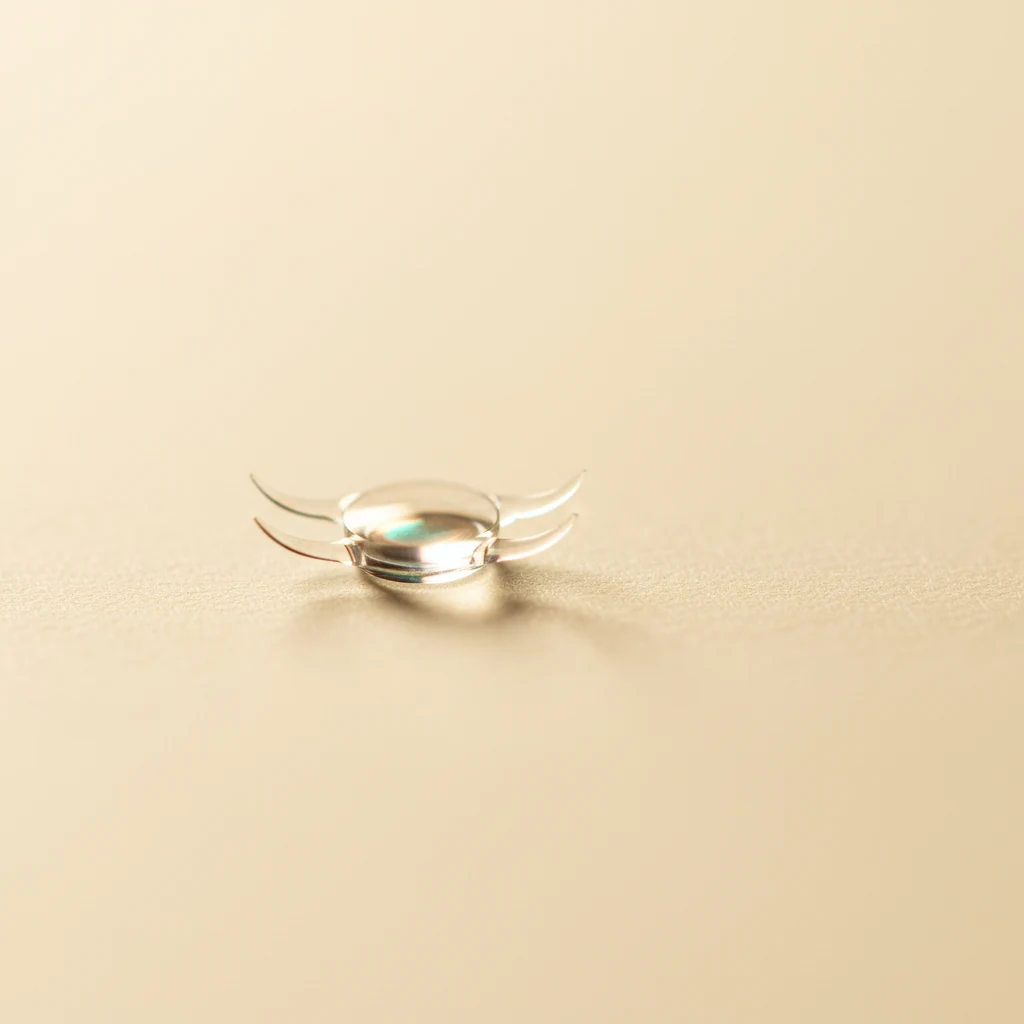
Cataract surgery is one of the few major procedures Medicare covers nearly in full — but only with a standard monofocal lens. The moment a patient asks about a "premium" IOL, the financial picture changes: an additional $1,000 to $4,000 per eye, paid out of pocket, that Medicare and most commercial insurance will not reimburse. The decision is not medical, exactly. It's a value judgment about what the patient is willing to pay for a different post-surgery vision experience — and the math depends on lifestyle, astigmatism severity, and tolerance for a few specific tradeoffs that the marketing materials tend to underplay.
This guide walks through what Medicare actually covers for cataract surgery, what "premium IOL" means in practice (it's a category, not one product), what each option costs in 2026, and the decision framework for whether the upgrade is worth it.
What Medicare covers — the baseline
Per the official Medicare cataract coverage rules, Medicare Part B covers cataract surgery that includes the implantation of a basic monofocal intraocular lens. After meeting the Part B deductible, the patient pays 20% of the Medicare-approved amount, whether the surgery is performed in a hospital outpatient setting or an ambulatory surgery center. Medicare also covers one pair of eyeglasses with standard frames (or one set of contact lenses) after each cataract surgery — a small but real benefit that recognizes monofocal IOLs typically leave the patient needing reading glasses or distance correction.
For typical out-of-pocket totals, see our companion guide on the cost of cataract surgery, which breaks down the standard-IOL pricing across all 50 states, and the Medicare-specific cataract surgery cost page that walks through Part A, Part B, and Medicare Advantage scenarios.
What Medicare does NOT cover, per CMS National Coverage Determination 80.12: any premium IOL technology — multifocal, toric, extended depth of focus (EDOF), or light-adjustable. The American Academy of Ophthalmology's billing guide for premium IOLs makes this explicit: "Medicare will pay what it would cost to restore functional vision — the fee for replacing the cataractous lens with a conventional IOL — and you can bill the patient for additional costs associated with the new lenses."
That structure is the entire premium-IOL economic story. The standard IOL is fully reimbursed. Anything beyond standard, the patient pays the difference, in cash, before surgery.
What "premium IOL" actually means — the four families
"Premium IOL" is a marketing umbrella for any lens technology beyond the standard single-focus monofocal. The four meaningful categories are:
Toric IOLs — astigmatism correction
Roughly one-third of cataract patients have clinically significant corneal astigmatism (typically defined as ≥1.0 diopter). A standard monofocal IOL corrects only the cataract; the astigmatism remains and the patient still needs corrective lenses for sharp distance vision. A toric IOL is a monofocal lens with an astigmatism-correcting axis built into the optic — the patient gets one focal distance (usually distance vision) plus astigmatism correction in a single surgery.
Toric IOLs are the most "rational" premium upgrade: they correct a real, measurable, structural eye condition that monofocal IOLs simply can't address. For patients with significant astigmatism, the alternative to a toric IOL is wearing toric contacts or progressive glasses for the rest of their post-cataract life. The value calculation is mostly about how much the patient values not depending on glasses for distance.
Multifocal IOLs — multiple focal distances
Multifocal IOLs are designed to give the patient sharp vision at multiple distances — typically distance and near (and sometimes intermediate). The optical design uses concentric rings of different focal lengths, and the brain learns to use the appropriate zone for each task. The promise: significant reduction in glasses dependence, including for reading.
The tradeoff: multifocal IOLs reliably produce halos around lights at night and reduced contrast sensitivity. Most patients neuroadapt over 3–12 months and the halos become tolerable; some patients never adapt and request explant. This is the IOL category with the highest patient-satisfaction variance, and it's the category where the surgeon's pre-operative screening matters most.
EDOF IOLs — extended depth of focus
EDOF (Extended Depth of Focus) IOLs are a middle-ground option: they extend the focal range continuously rather than offering discrete distance and near zones. The result is good distance and intermediate vision with modest near vision — most patients still need readers for fine print but less than with a standard monofocal. EDOF IOLs typically produce fewer halos than multifocals and are often recommended for patients who want some glasses-reduction but can't tolerate the multifocal optical compromise.
Light Adjustable Lens (LAL) — post-implant customization
The RxSight Light Adjustable Lens is a different kind of premium IOL. It's a monofocal lens whose power can be fine-tuned after implantation using ultraviolet light treatments at the surgeon's office, typically 3–5 sessions starting about three weeks post-surgery. The pitch: the surgeon can customize the lens to the patient's actual healed eye rather than betting on pre-surgical measurements alone.
The clinical data is impressive. A peer-reviewed cost-effectiveness analysis (Journal of Refractive Surgery, 2024) reported that 92% of LAL eyes achieved results within 0.50 diopters of the target refraction, and patients were approximately 2x more likely to achieve 20/20 vision without glasses at 6 months compared to monofocal IOL controls. The LAL is also the only IOL in the United States approved to correct astigmatism as low as 0.50 D — useful for patients with mild astigmatism that wouldn't normally justify a toric IOL. The same analysis found the LAL cost-effective vs. monofocal at $9,792/QALY, well within the standard cost-effectiveness threshold for medical interventions.
The catch: the post-surgery adjustment process requires the patient to wear UV-protective glasses for several weeks and return to the surgeon's office multiple times. It's the IOL with the most patient logistical commitment.
What each option costs per eye in 2026
The following ranges reflect typical out-of-pocket costs for the lens upgrade only — over and above whatever the patient would have paid for standard cataract surgery with a monofocal IOL. Actual prices vary significantly by surgeon, geography, and bundled fees (some practices include the femtosecond laser cost in the premium IOL package; others bill it separately).
- Toric IOL — $1,500 to $3,500 per eye, with an average premium of about $1,370 per eye over standard.
- Multifocal IOL — $2,000 to $4,000+ per eye, with high-end premium multifocals (Alcon PanOptix, J&J Tecnis Synergy) reaching $4,250 per eye at some practices.
- EDOF IOL — $2,000 to $3,000 per eye.
- Light Adjustable Lens — typically a few hundred to about $2,000 per eye over standard, depending on practice. The post-surgery UV treatments are usually included in the lens package; ask the surgeon's billing office to confirm.
- Femtosecond laser-assisted cataract surgery (often bundled with premium IOLs) — adds $500 to $1,500 per eye, separately billed in some practices.
For a patient choosing premium IOLs in both eyes, the total out-of-pocket can range from approximately $3,000 (two toric IOLs at the low end) to $10,000+ (two premium multifocals with femtosecond laser at the high end). For broader context on what to expect from any major surgery's bill structure, see our guide to what surgery actually costs.
The decision framework — when each premium IOL is worth it
Premium IOL marketing tends to assume the answer is "yes" and frame the question as "which one." The honest framework is the opposite: start with whether you need any premium upgrade, then narrow within the categories.
You probably want a toric IOL if
You have ≥1.0 D of corneal astigmatism (the surgeon will measure this pre-operatively), you currently wear corrective lenses primarily for distance, and you'd value not needing distance glasses post-surgery. Toric IOLs have the cleanest cost-benefit profile of the premium options because they correct a measurable structural condition with no significant optical tradeoff. The downside is purely financial.
You probably want a multifocal or EDOF IOL if
You're highly motivated to reduce glasses dependence at all distances, you don't drive at night routinely (or you can tolerate halos if you do), and you understand the neuroadaptation period is real and the optical compromise is permanent. Multifocals favor patients who do significant near work (reading, sewing) and can accept some night-vision compromise. EDOFs favor patients prioritizing distance and intermediate vision (computer work, dashboard) with less near demand.
Multifocal patients with high astigmatism may need a toric multifocal — these exist but are at the highest end of the cost range.
You probably want a Light Adjustable Lens if
You have a complex eye history (prior refractive surgery, irregular cornea), you have mild astigmatism (0.50–1.0 D) that's below the threshold for a typical toric IOL, or you place high value on customized post-surgery refractive accuracy and you're willing to commit to multiple post-op visits and several weeks of UV-protective glasses. The LAL is the premium IOL with the strongest published refractive-accuracy data and the most patient-side logistical commitment.
You probably don't need a premium IOL if
You don't have significant astigmatism, you're comfortable wearing reading glasses (a standard monofocal set for distance leaves you needing readers for near), and you'd rather direct $2,000–$8,000 toward something else. A standard monofocal IOL produces excellent distance vision in most patients and is what the FDA originally approved for the cataract surgery population. There's no clinical reason to upgrade if the lifestyle pull isn't there.
The tradeoffs the marketing materials underplay
Three things to know before signing the consent form:
1. Halos and reduced night vision are real with multifocals and EDOFs. Pre-screening helps surgeons identify patients likely to neuroadapt well, but no screening is perfect. If you're a long-haul truck driver or routinely drive in heavy night rain, the multifocal IOL is probably not the right call.
2. IOL implants are essentially permanent. Explanting a premium IOL because the patient can't tolerate the halos requires a second surgery, and not all surgeons will perform an explant on a patient who chose the IOL. This is the main reason to take the pre-surgery consultation seriously and to be honest about lifestyle and tolerance for compromise.
3. The "premium IOL upgrade" includes the IOL itself but often not the complete refractive package. Premium IOL bundles sometimes include enhanced biometry, intraoperative aberrometry, femtosecond laser-assisted incisions, and post-op enhancement (LASIK touchup if the refraction lands off-target). Some practices bundle these; others bill separately. Ask for an itemized estimate before scheduling.
Questions to ask your cataract surgeon
- What's my measured corneal astigmatism, and does it meet the threshold for a toric IOL?
- Based on my pre-op measurements and lifestyle, which premium IOL category — if any — would you recommend?
- What's the all-in price per eye for each premium option, including any associated technology (femtosecond laser, intraoperative aberrometry, post-op enhancement)?
- If I choose a multifocal or EDOF IOL and don't neuroadapt, what's your explant policy and what would the cost be?
- For the Light Adjustable Lens specifically, how many post-op UV treatment sessions are typical, and are they included in the lens package price?
- What's the cash-pay vs. insured pricing difference for the standard cataract portion of the bill?
The bottom line
Premium IOLs are a real category of medical technology with real clinical benefits — toric IOLs correct astigmatism that monofocals can't, multifocals reduce reading-glasses dependence, EDOFs extend functional range, and the Light Adjustable Lens delivers customizable post-implant refractive accuracy. They are also a $1,000–$4,000-per-eye out-of-pocket decision that Medicare and most insurance won't cover.
The right framework is to start from "I will get a standard monofocal IOL covered by Medicare" and ask what specifically I'd be buying with the upgrade — astigmatism correction, glasses reduction, post-surgery customization — and whether that specific benefit is worth the specific cost in my specific lifestyle. The answer for some patients is clearly yes (significant astigmatism, active near-work lifestyle, complex eye history). For others, it's clearly no. The marketing materials tend to assume the first answer; the honest pre-surgery conversation should treat both as valid.
For comprehensive cost data on the underlying cataract surgery itself, see our state-by-state cataract surgery cost page. For other major surgeries where the line-item structure matters as much as the headline price, our guide to surgery cost composition walks through the surgeon-facility-anesthesia separation that produces most surprise bills. For tactics on negotiating bills that arrive larger than expected, see how to negotiate surgery bills in 2026.